| Head of the Department: |
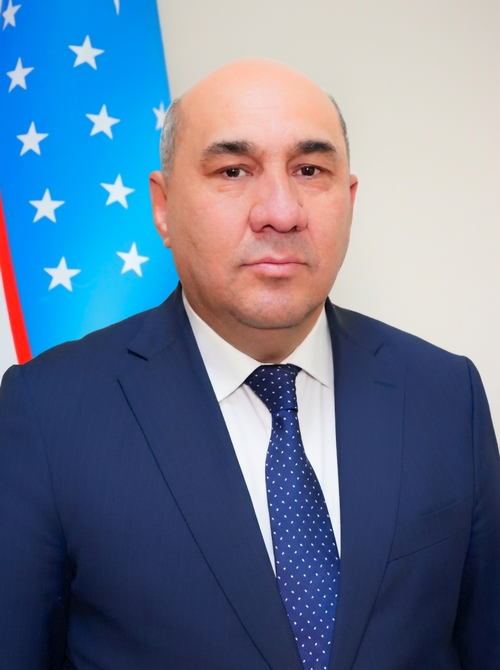
ISMAILOV RIXSILLO KHAMIDOVICH⌚ Reception hours: every day from 14:00 to 17:00. |
| About the Department for Educational Quality Control: |
| The department carries out its activities in accordance with the Constitution of the Republic of Uzbekistan, the Law of the Republic of Uzbekistan “On Education”, decisions of the chambers of the Oliy Majlis of the Republic of Uzbekistan, decrees, resolutions and orders of the President of the Republic of Uzbekistan, resolutions and orders of the Cabinet of Ministers of the Republic of Uzbekistan, orders and lawful instructions of the Ministry of Higher Education, Science and Innovation, as well as orders of the rector of the institute and the Regulation on the Department. Information about the work carried out, existing problems and shortcomings is regularly submitted to the rector of the institute, the vice-rector for academic affairs and the State Inspectorate. |
| Goals and objectives of the Department for Educational Quality Control: |
| • analyzing and examining the provision of educational programs and specialties with State Educational Standards (SES), qualification requirements, curricula and course syllabi; • studying the quality of the educational process at the institute and the level of its provision with educational literature and teaching materials; • monitoring and analyzing the compliance of students’ knowledge with the requirements of the State Educational Standards; • ensuring the implementation of regulatory and legal documents aimed at improving the quality of education; • conducting monitoring of the quality of personnel training; • organizing internal attestation of the institute, identifying factors negatively affecting the quality of education and submitting relevant information to the rector of the institute and the Ministry of Higher Education, Science and Innovation; • supervising the timely elimination of deficiencies and violations identified during attestation and educational quality assessment processes; • monitoring indicators determining the quality of education and submitting proposals to relevant structural divisions regarding identified problems and shortcomings; • analyzing the effectiveness of modern methods and approaches used in the professional development of the teaching staff; • conducting internal monitoring of the professional qualifications of pedagogical staff in the structural units of the institute; • analyzing whether the academic background of teaching staff corresponds to the subjects they teach; • jointly with the academic department, monitoring the implementation of educational, research and methodological work plans; • analyzing the condition of the material and technical base of the educational process and preparing proposals for its development and improvement; • supervising the organization and effectiveness of students’ practical training; • participating in the collection of information related to determining and evaluating the institute’s ranking upon the instruction of the State Inspectorate; • evaluating the objectivity, transparency and quality of the student knowledge assessment system; • regularly conducting social surveys among students, parents, professors, teachers and employers; • improving the professional competence of department staff and studying the experience of prestigious foreign educational and scientific centers; • actively participating in the development and implementation of measures aimed at increasing the institute’s international ranking; • organizing seminars and training sessions aimed at improving the quality of education; • forming a database of public experts and organizing seminars with their participation; • monitoring integration cooperation between the educational process and industry, as well as the implementation of innovative ideas and technologies; • submitting proposals to the institute’s management based on the analysis of educational quality. |
| Regulatory documents of the Department for Educational Quality Control: |
| Results of the Department’s activities: |
| Uzbekistan State Institute of Arts and Culture has achieved notable positions in several prestigious international rankings in recent years, demonstrating achievements in educational quality, innovation and sustainable development. These results increase the institute’s international academic reputation and confirm that its scientific and educational potential is recognized at the international level.
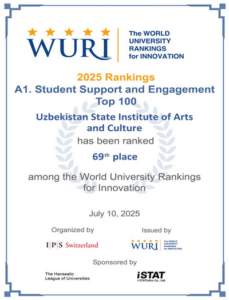
The institute’s activities have also been recognized in the international ranking “World University Rankings for Innovation (WURI)”. This global ranking is organized by leading universities from America, Asia, Europe and Africa and evaluates higher education institutions based on achievements in innovative education, research, entrepreneurship and cooperation with society.
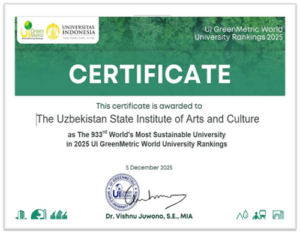
In addition, Uzbekistan State Institute of Arts and Culture entered the TOP-1000 universities of the “UI GreenMetric World University Ranking 2025” for the second time, ranking 933rd.
Furthermore, Uzbekistan State Institute of Arts and Culture was included in the “Schools of Excellence in Arts & Luxury” list of the Eduniversal international ranking.
In the 2025 “Schools of Excellence” ranking in the “Arts & Luxury” category, Uzbekistan State Institute of Arts and Culture ranked 3rd in Central Asia.
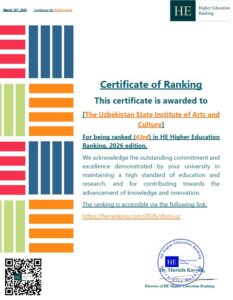
Uzbekistan State Institute of Arts and Culture ranked 43rd in the TOP-100 of the international HE Higher Education Rankings. This ranking evaluates the activities of higher education institutions based on a comprehensive set of academic, scientific, and research indicators and contributes to improving their overall performance. The ranking results are published annually and include leading universities from around the world. The evaluation system analyzes university performance according to various criteria and indicators, including quality of education, scientific research, innovation, digital capacity, and compliance with sustainable development principles. This achievement once again confirms the institute’s reputation and development potential in the international educational arena. |

The Uzbekistan State Institute of Arts and Culture
О‘zbekiston, Toshkentuzdsmi@madaniyat.uz(71) 230-28-02, 230-28-15